
From Model Intelligence to Enterprise Intelligence: How Informatica + Claude Ground AI in Trusted Data
Table Of Contents
Introducing the Informatica Plugin for the Claude Enterprise
After an initial wave largely about model intelligence and model smarts, such as how well an AI system could generate, summarize, analyze and reason, Enterprise AI is now entering a new phase. The next wave is about enterprise intelligence and context: whether that AI system understands the language, data, policies and relationships that make a business unique.
Platforms such as Claude are increasingly becoming work surfaces where employees search, analyze, create, reason and execute multi-step work. They can connect to enterprise applications, repositories and scattered data sources. But connectivity alone doesn’t provide the intelligence required to understand what enterprise data means, which source is authoritative, whether the data can be trusted, where it came from or who is permitted to use it.
That intelligence is the critical capability the Informatica Plugin for Claude delivers.
Now part of Salesforce, Informatica unlocks governed, high-quality, AI-ready data from across the entire enterprise estate for Claude users, propelling it beyond just connecting to the enterprise to being context-aware about the enterprise.
The Informatica plugin helps close Claude's enterprise blind spots by introducing governed, high-quality, AI-ready data into the Claude experience – allowing Claude to work with the right data, definitions and business context.
The Enterprise AI Problem: Connectivity is only part of the solution
Modern AI platforms are becoming exceptionally good at reaching information. An enterprise assistant can potentially search documents, CRM records, support conversations, databases, collaboration systems and other applications.
But what if you ask:
“What was EMEA’s revenue last quarter?”
Behind that seemingly simple and often queried question lie several questions an AI system must answer correctly.
- What exactly does the company mean by “revenue”?
- Is it booked revenue, recognized revenue, net sales or gross sales?
- What constitutes EMEA?
- What is the company's fiscal definition of “last quarter”?
- Which of several datasets is the certified source?
- Has that dataset been refreshed recently?
- Is the information of sufficient quality for an executive decision?
This disconnect creates three fundamental enterprise AI gaps:
- The Knowledge Gap: where different names, labels or IDs across disparate enterprise tools may represent the same business concept or same real-world entity.
- The Trust Gap: when faced with conflicting information, an AI tool may retrieve multiple answers without knowing which is authoritative, high-quality and up to date.
- The Action Gap: where an AI system may know what it wants to do but cannot independently determine whether the underlying information is accurate, governed or authorized for that purpose.
Informatica is uniquely positioned to help close those gaps because the Informatica Intelligent Data Management Cloud (IDMC) already combines metadata intelligence, business context, lineage, data quality, observability, master data management, governance, privacy, integration and other enterprise critical capabilities, resulting in a powerful division of responsibilities.
Claude provides the reasoning engine. Informatica provides the trusted enterprise data management capabilities that reasoning operates on.
What Is a Claude Plugin?
A Claude plugin packages specialized skills, instructions and connections to enterprise systems, extending Claude’s out-of-the-box capabilities.
Now available on the Claude’s Plugin Marketplace, Informatica’s plugin seamlessly integrates with the Claude Enterprise Platform (including Claude CoWork and Claude Code) addressing the Knowledge, Trust, and Action gaps in the enterprise covered above. Informatica’s AI-powered data management platform enriches Claude's agentic workflows with deep understanding of enterprise data – clarifying business definitions, pointing to single sources of truth, checking lineage, mapping relationships, and confirming safety guidelines before executing actions.
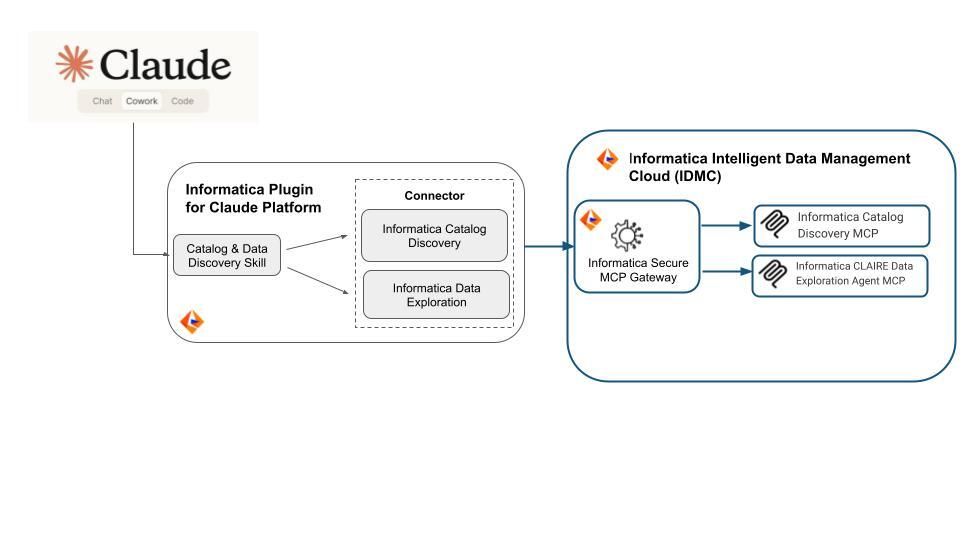
At its core, the Informatica plugin implementation combines a reusable Catalog and Data Discovery Skill with connectors that communicate with Informatica’s headless data management Model Context Protocol (MCP) services. The plugin teaches Claude not just where to retrieve information but how to discover and evaluate data across the enterprise before using it.
Key Features
Catalog and Data Discovery Skill: The skill provides instructions and reusable workflows to Claude on how to perform specific metadata-only discovery from Informatica's Cloud Data Governance and Catalog service. Additionally, it informs Claude on how to inspect data assets – tables, columns, glossary terms, ownership, certification, and PII/sensitivity tags – thus verifying that the asset is fit for purpose before handoff to the data discovery and execution tool. It also ensures that LLM adheres to strict anti-hallucination guardrails, treating missing metadata as an explicit gap rather than guessing. Once a trusted asset is identified, it passes verified information to downstream data exploration tools.
Connectors: These components handle secure communication, linking Claude directly to Informatica's MCP endpoints (including the Catalog Discovery MCP and the CLAIRE Data Exploration Agent MCP) via Informatica’s Secure MCP Gateway.
Informatica Catalog Discovery MCP: Serving as the primary gateway to Cloud Data Governance and Catalog (CDGC), this MCP gives AI agents the ability to navigate and inspect enterprise data assets easily. Using natural language queries or specific keywords, AI agents can surface rich metadata, explore data dependencies, and ground every answer in a governed enterprise information.
Informatica CLAIRE Data Exploration Agent MCP: Designed as a specialized interface for CLAIRE's (Informatica’s AI powered engine) data exploration features, this MCP grants AI agents direct access to dataset and attribute telemetry inside IDMC. Sitting downstream from orchestration, it lets systems with concrete analysis goals interact directly with underlying data assets safely and efficiently.
Plugin Overview
One Plugin, Two Enterprise Audience Personas
Informatica’s Plugin for Claude Platform offers value to two distinct user groups.
Business users: From asking questions To reaching trusted decisions
For executives, line-of-business leaders, sales leaders, finance executives, operations teams and other business users, the complexity of metadata management must largely remain invisible. They generally want answers to questions like:
“What happened to revenue in Europe last quarter?”
“Which suppliers are affected by this product recall?”
“Why did our customer churn rate increase?”
“Which customers represent the largest renewal risk?”
“What do I need to have prepared for the meeting with Acme tomorrow?”
The Informatica plugin enriches these conversations with the context required to distinguish a trusted enterprise answer from a generic answer.
Take an account briefing, for example. Claude can already retrieve emails, CRM content, meeting notes and support conversations. But Informatica adds an extra layer: gathering an authoritative customer identity, account hierarchy, mastered attributes, product relationships, certified revenue definitions, relevant datasets, quality information, lineage and sensitivity classification.
This combination of unstructured work context plus trusted enterprise data context materially improves the performance of an enterprise assistant.
Technical users: From finding data To understanding whether it should be used
The Informatica plugin for Claude Platform offers a different experience for data personas like data analysts, data engineers, data scientists, data stewards and AI developers.
Their questions are more likely to be:
“Which dataset should I use for this analysis?”
“Where did this metric originate?”
“What downstream dashboards are affected if I change this column?”
“Is this data certified?”
“Does this dataset contain sensitive information?”
“Which business definition applies to this field?”
For these users, Informatica becomes the contextual bridge between natural-language reasoning in Claude and the underlying enterprise data estate. The source documents map analysts to catalog, glossary, lineage and data quality capabilities; data engineers to lineage, observability and integration; data stewards to governance, quality and MDM; and AI developers to MCP, APIs, catalog, MDM and data-quality services.
From Business Question to Technical Execution
The key message today is not simply that Claude can connect to Informatica, but how the combination of the two translates the business question into a trusted technical workflow.
This Informatica plugin for Claude Enterprise turns enterprise metadata from something primarily consumed by data-management specialists into something that can actively participate in everyday AI reasoning.
A Simple Prompt That Shows How Enterprise Intelligence Matters
Below is a simple but often used prompt:
“Run quarterly sales EMEA in Q2.”
A conventional AI workflow might immediately start searching for a field called sales, look for a region value called EMEA, and interpret Q2 as calendar year Q2 April through June. Any one of those assumptions has the potential to deliver a wrong answer confidently.
This is where the Informatica-enabled workflow diverges from similar tools, as the plugin initially uses catalog intelligence to resolve the terminology. The walkthrough below illustrates scenarios where the company's fiscal quarter differs from the calendar quarter, “EMEA” is represented through individual countries rather than a literal EMEA value, and multiple revenue fields exist but only one is the approved/certified reporting measure.
Once those terms have been grounded in authoritative enterprise metadata, Claude can move from interpretation to analysis. This is the difference between retrieval and enterprise reasoning. The same model applies far beyond financial analysis.
- An insurance executive could investigate underwriting or claims performance.
- A supply-chain leader could analyze supplier exposure.
- A sales executive could prepare for an account meeting.
- A compliance officer could ask how a risk score was derived.
- A data engineer could investigate why a dashboard changed following an upstream pipeline modification.
From Model Intelligence to Enterprise Intelligence
The enterprise AI conversation is moving beyond model smarts to enterprise intelligence. “What does the model know about my business, my data and rules under which my business operates?” Where once, “How smart is the model?” was the important question, it’s been replaced by a bigger question: “What does the model know about my business, my data and rules under which my business operates?”
Data is the strategic asset of every organization, and enterprise intelligence is built upon that trusted data foundation. Enterprise intelligence and understanding include business definitions, authoritative identities, relationships, quality, freshness, lineage, certification, sensitivity, policies, ownership and permitted actions. Informatica’s Plugin for Claude Platform provides that trusted envelope surrounding the data presented for AI.
To summarize, Claude provides sophisticated reasoning and an increasingly powerful work surface. Informatica adds the semantic, metadata, quality and governance context required to apply that reasoning to enterprise data.
Together, that moves enterprise AI one important step forward.
See for Yourself
A new report from Futurm Research reveals that 55% of tech leaders say hallucinations and unreliable agents are their biggest scaling blockers, and they say it's due to enterprise agents operating "context blind", disconnected from your governed data, lineage and business definitions.
Informatica's Intelligent Data Management Cloud, integrated with Claude via MCP, does the opposite: turning raw enterprise data into trusted, audit-ready context – cutting hallucinations, token costs and compliance risk at the same time.
The report also details:
- Why naive RAG and direct API access quietly poison agent decisions
- How governed metadata, master data management, and real-time lineage fix it
- A 4-phase roadmap to move from chat-based AI pilots to production-grade agents
Your AI agents are only as smart as the data supporting them. Download the full Futurum Research report and see if your AI stack is ready for enterprise-scale trust.