
Building a Future-Proof Compliance Strategy for KYC/AML Regulations and Data Management
Table Of Contents
Table Of Contents

If you’re leading compliance at a bank or insurance company, you know the relentless tide of data never eases — from client details and identity verification records to transaction logs and sanction alerts. Whether your team focuses on KYC during onboarding or AML transaction monitoring, managing this vast and varied information for your compliance strategy is a constant battle against fragmentation, inaccuracies, and delays.
Meanwhile, criminals don’t sit still. They constantly evolve, hiding behind complex ownership structures and exploiting new financial channels like crypto and luxury goods. Regulators worldwide are racing to keep up, as bad actors move from simple scams to sophisticated laundering schemes involving shell companies and emerging technologies.
The European Union’s 6th Anti-Money Laundering Directive (6AMLD), the upcoming Anti-Money Laundering Regulation (AMLR), and new laws in the UK and U.S. are all raising the stakes, demanding more transparency, faster detection, and tighter cross-border cooperation to combat the problem. It’s a challenge so huge, in fact, that the United Nations Office on Drugs and Crime (UNODC) estimates that 2-5% of global GDP (trillions of dollars) is laundered every year.
“The United Nations Office on Drugs and Crime (UNODC) estimates that 2-5% of global GDP, amounting to trillions of dollars, is laundered every year.”
If that doesn’t make you sit up straight, what will?
Navigating Complex KYC/AML Regulations: From 6AMLD to AMLR
The KYC/AML regulatory landscape feels like a moving target. From Europe to the U.S., Asia-Pacific to the UK, the rules are shifting and piling on:
- 6AMLD expands AML rules to cover cybercrime and environmental offenses, with bigger penalties.
- AMLR aims to unify AML and KYC requirements across Europe, standardizing customer due diligence (CDD) and enabling real-time monitoring.
- The UK’s Economic Crime Act tightens rules on ownership transparency and regulator collaboration.
- The U.S. Anti-Money Laundering Act of 2020 introduces a registry to expose hidden owners and clamps down on identity checks.
- Singapore, Hong Kong, and Australia are enhancing counter-terrorism finance (CTF) measures and cross-border data sharing.
If your compliance strategy spans across regions, you know this means juggling different rules and deadlines, without any margin for error.
How Disconnected Compliance Tools Undermine Your KYC/AML Strategy
Many finance firms still rely on separate compliance tools bought and built separately for sanctions screening, identity verification, and transaction monitoring. This patchwork creates real headaches:
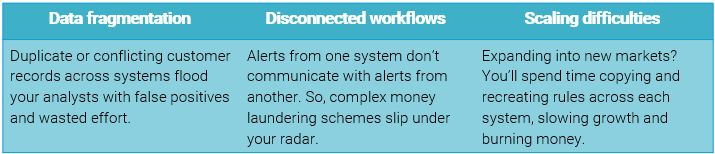
Regulators have taken notice. They warn that too many false positives don’t just waste your team’s energy; they weaken your entire KYC/AML compliance program. Worse, disguised ownerships and layered trade-based laundering often go undetected, exposing your bank to serious fines and reputation damage.
How AI and Intelligent Data Management Strengthen KYC/AML Compliance
Your KYC/AML compliance programs don’t succeed on rules alone. They need data you can trust. When your data is scattered, outdated, or incomplete, even the smartest alerts become noise. Consider everyday compliance data management challenges like:
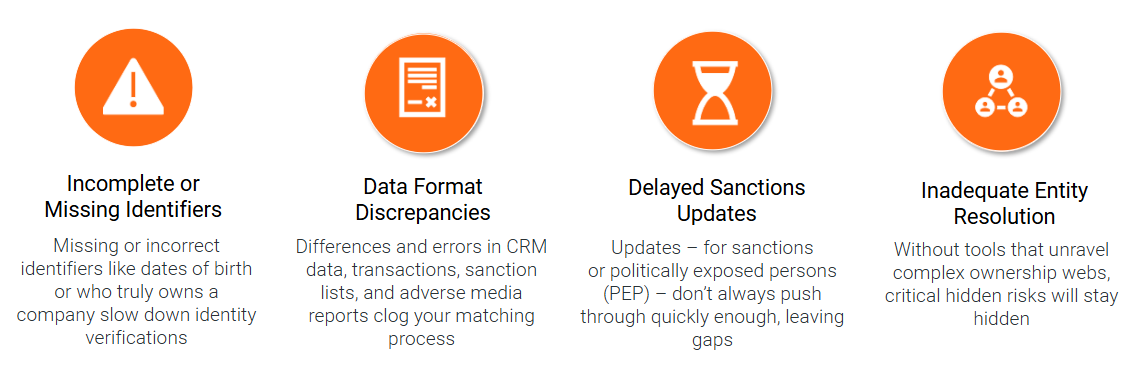
Modern compliance solutions combine clean data, AI, and automation to deliver clearer, faster, and smarter KYC/AML compliance programs. Imagine agentic artificial intelligence (AI) engines that:
- Pull customer records, transactions, and public information into a single, clear investigation view.
- Spot missing or outdated data and automatically enrich profiles, so your team has what they need, right away.
- Dynamically prioritize alerts so analysts can focus on real threats, not noise.
- Adapt on the fly to new risks, regulations, and geopolitical shifts.
- Uncover hidden links behind complex ownership and trade layers that slip past traditional tools.
But even the best AI can’t do its job without clean, consistent data feeding it. That’s why intelligent data management is crucial. It’s the foundation that turns AI insights into real risk reduction.
Why Intelligent Data Management Matters to Your KYC and AML Teams
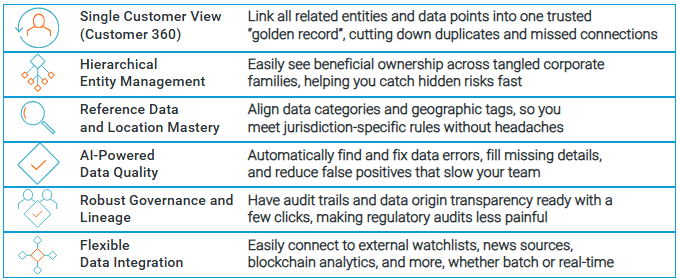
Financial services data is complicated — involving companies with multi-layered subsidiaries across the globe, varied products and transactions governed by unique local rules, and intricate relationships between accounts, counterparties, and locations. This complexity can overwhelm even the most experienced KYC and AML teams unless supported by a platform designed for it.
Informatica Intelligent Data Management Cloud (IDMC) helps put this tangled web into order, delivering trustworthy, actionable data for your KYC/AML compliance programs. Here’s how IDMC supports you:
Building Your Future-Ready KYC/AML Compliance Strategy
New regulations, smarter criminals, and emerging risks like crypto and environmental crimes mean the KYC/AML landscape is set to keep shifting. Sticking with patchwork solutions won’t cut it anymore, so ask yourself:
✅Can your data strategy easily bring together all your sources to give you a clear, unified compliance view?
✅ Do your KYC and AML investigators get fast access to trustworthy data that supports confident, timely decisions?
✅ How quickly can your detection systems adapt to new rules, threats, and intelligence?
✅ Are you ready to deploy AI tools? Is your data foundation solid enough to support AI?
If you’re hesitating or spotting gaps, it’s time to reassess your approach. Building a future-proof KYC/AML program begins with intelligent, resilient data management.
Ready to Strengthen Your KYC/AML Compliance Strategy?
Don’t wait for fines or reputation damage to force a change. Informatica is ready to help you build an agile, trustworthy compliance framework designed specifically for banks, insurers, and financial services.
Reach out to your Informatica rep or email us at informaticaemeamarketing@informatica.com to evaluate your KYC/AML readiness and take your compliance program to the next level.
Learn more about how Informatica can help banking, financial services, and insurance companies meet these regulatory demands in our latest webinar series.