From Data to Decisions: How Informatica and Azure AI Foundry Power Enterprise AI Agents?
Table Of Contents
Table Of Contents
As enterprises adopt Agentic AI and AI-driven automation, one reality becomes clear: High quality and trusted data is an essential requirement for adoption of AI systems. Yet, many organizations struggle to bridge the gap between fragmented data systems and rapidly evolving AI capabilities.
This blog highlights how Informatica’s Intelligent Data Management Cloud (IDMC), powered by IDMC MCP (Model Context Protocol) Servers, integrates seamlessly with Azure AI Foundry to create context-aware agents that turn enterprise data into automated, trusted decisions. We’ll explore enterprise agents, the data challenges, the integration path, and how a blueprint with Azure AI Foundry and Informatica’ Intelligent Data Management Cloud (IDMC) Services enables AI use cases that combine data governance with AI reasoning .
The Data Ecosystem behind a successful Enterprise Agentic AI system
As enterprises build scalable and intelligent agents, copilots etc., they require a powerful data ecosystem to enable this AI system. Enterprises today manage data that is distributed, dynamic, and diverse — spanning multiple clouds, applications, and regulatory frameworks. The enterprise data that fuels this innovation, however, is often siloed, duplicated, or ungoverned. The result: AI systems built on inconsistent or incomplete data deliver insights that can’t be trusted and cannot drive the desired business outcomes.
Traditional integration tools fall short when AI systems need real-time access to contextual, high-quality data. What enterprises need is a governed data foundation that feeds directly into intelligent systems — ensuring that every AI-driven decision is explainable, compliant, and based on trusted data
IDMC MCP Servers
In Agentic and AI systems, there must be a seamless connection or a contextual bridge between the AI agents and data for the enterprise; for the many enterprises using Azure Open AI, this bridge is provided by Azure AI Foundry and Informatica’s Intelligent Management Cloud (IDMC)’s Model Context Protocol (MCP) servers .
MCP is a standardized protocol that allows data services, models and agents to communicate with shared context enriching the agents’ reasoning within enterprise AI systems. The tools within IDMC MCP provide task-oriented autonomous data management services to work with the enterprise AI agents to ensure that the enterprise data managed by IDMC is of high-quality, high-fidelity and trustworthy.
By deploying Informatica’s IDMC MCP Server for data management, organizations can expose curated, trusted datasets and their metadata, lineage, and policies to downstream AI systems securely and dynamically. This ensures that any model or agent interacting with the data does so within the boundaries of enterprise governance.
As enterprises use MCP as the standard for connecting and integrating enterprise agents with their data, IDMC MCPs addresses the core data management challenges they face during enterprise AI implementations.
Data Discovery, Exploration and Integration
AI Agents need to find the right data across the distributed systems without knowing where it rests or how it is structured. IDMC MCP servers provide intelligent data discovery through semantic metadata exposure, allowing users to query for the purpose rather than knowing the specific table schema or system on which the data is stored. With 300+ enterprise connectors, IDMC automatically maps and catalogs data assets from cloud, on-premises, and hybrid locations, exposing them through MCP with business-friendly descriptions using enterprise glossary, data usage statistics and data quality metrics. Agents can dynamically discover available datasets, understand their context, and access them through unified APIs.
Privacy and Data Access
Enterprise data contains sensitive information subject to regulations like GDPR, HIPAA and CCPA. IDMC MCP servers enforce enterprise-wide data access policies and fine-grained access control across the enterprise data sources at the data attribute layer, ensuring agents only access data appropriate for each user’s role and the request context. When an agent requests data, IDMC MCP evaluates the requesting user’s permissions, the agent’s purpose and other applicable privacy policies before providing the data – creating an intelligent authorization layer that prevents unauthorized access while enabling legitimate AI use cases.
Governance and Lineage
For AI systems to be trusted and auditable, organizations must understand the complete data journey from source to insight. IDMC MCP servers provide end-to-end data lineage tracking, showing exactly which source systems, transformations, and quality rules contributed to the agent execution. The deep lineage provides the hops it took to navigate from source to target and understand how the quality of the data improved or deteriorated through the data journey. When an agent makes a recommendation, IDMC can generate an audit trail proving the data's origin, transformation history, and compliance status through its AI Governance layer. This aspect of governance is critical for enterprises where AI decisions must be explainable
Quality and Mastered Data
AI agents amplify data quality issues — garbage in, garbage out at machine speed. IDMC MCP servers expose pre-validated, high-quality data through built-in data profiling, cleansing, and standardization services. Rather than agents working with raw, potentially inconsistent, data from multiple systems, they receive golden records from IDMC's Master Data Management (MDM) capabilities. When an agent needs customer information, IDMC's MCP server provides the unified, deduplicated master record that resolves a customer name like “John Doe” across CRM, billing, and support systems into a single, authoritative profile. Agents can also invoke IDMC's data quality tools on-demand — validating addresses, standardizing phone numbers, or flagging suspicious data patterns — ensuring every AI interaction is grounded in trusted, enterprise-grade data.
By addressing the above four foundational challenges, IDMC MCPs transform enterprise data into an AI enabler — giving agents the context, quality, and governance required to deliver trustworthy business outcomes.
Connecting IDMC Agents with Azure AI Foundry
The convergence of Informatica IDMC and Azure AI Foundry creates a powerful enterprise AI fabric that combines best-in-class data management with intelligent agent orchestration — establishing the foundation for deploying production-ready, data-grounded AI agents on a scale.
Let's explore how this agentic blueprint works in practice.
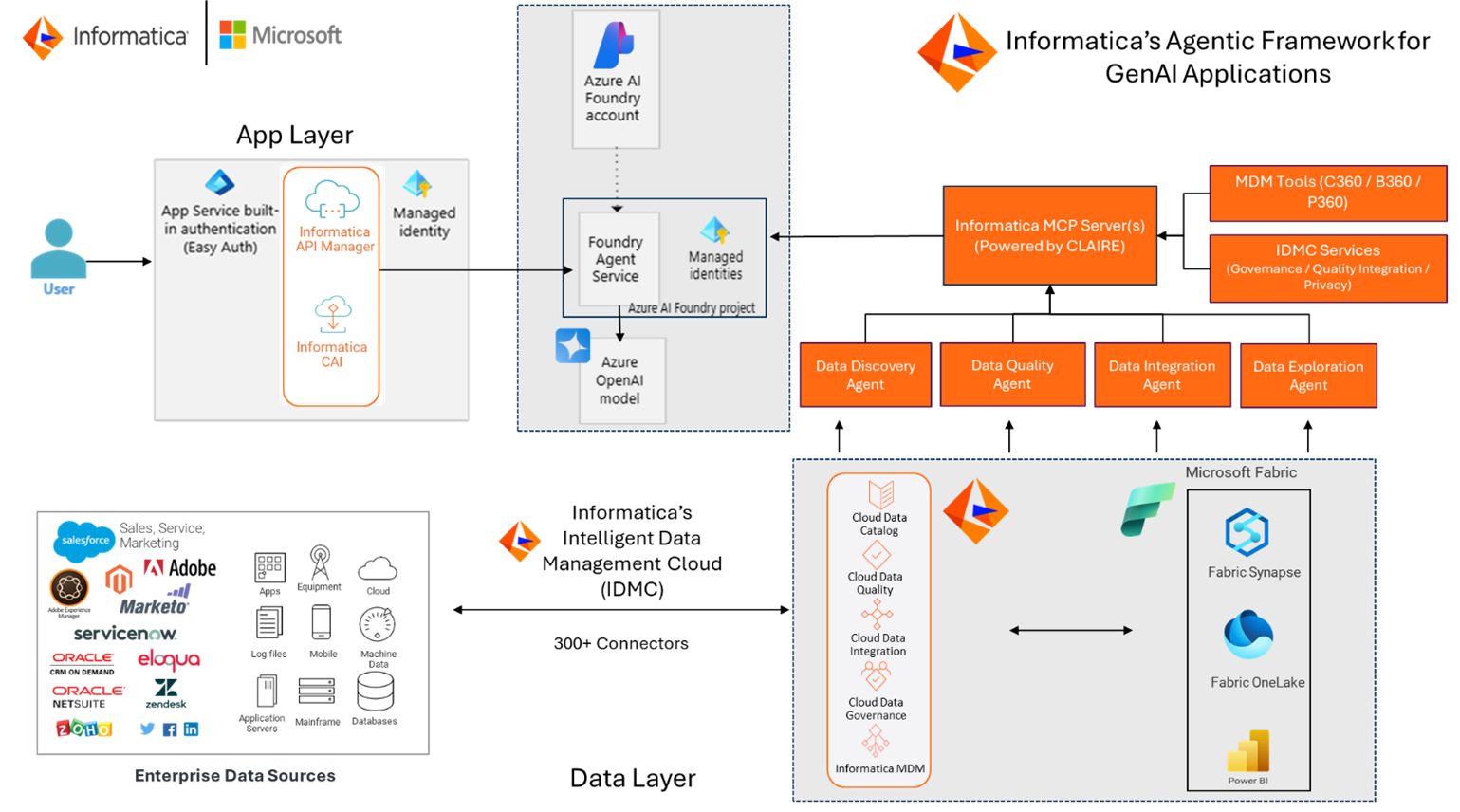
Figure 1. Informatica's Agentic Framework for GenAI Applications
App Layer (User Interface and Access)
The App Layer serves as the secure gateway between users and the AI agent ecosystem, enabling interaction through familiar enterprise interfaces like Microsoft Teams, Copilot, and custom applications. Beyond providing multi-channel access, this layer implements critical security controls through Informatica's API Management, protecting against common enterprise threats including Denial-of-Service (DoS) attacks through rate limiting and traffic throttling, and SQL injection vulnerabilities through input validation and parameterized query enforcement. Integrated with Azure Active Directory for authentication and centralized user governance.
Azure AI Foundry and AI Agent Orchestration
The Azure AI Foundry layer serves as the cognitive orchestration hub, the deployed agents get invoked through Informatica’s API Manager, and these agents intelligently routing user requests to specialized MCP servers (data discoverability, data quality, data integration, data marketplace, etc.) based on the i ntent and context. The Foundry Agents manage the complex multi-step process by breaking into subtasks, delegating them to appropriate autonomous agents and MCP servers powered by Azure OpenAI models.
Informatica IDMC (Intelligent Data Management Cloud) MCP servers
The Informatica MCP (Model Context Protocol) servers are powered by CLAIRE, Informatica’s AI Engine that provides specialized tools for distinctive data management functions (including Data Integration, Data Discoverability, Data Governance, Data Exploration, Product Experience and Master Data Management services). These MCP servers act as intermediaries between Azure AI Foundry agents and enterprise data sources, exposing domain-specific capabilities that enable access data as well as validating quality, enforcing governance policies, and resolving and providing unified master data (aka golden records). By combining these services, the MCP layer ensures all agents interact with grounded, context-aware data, and act as the contextual bridge for high-quality and trusted data from verified sources – preventing not only unauthorized usage but also avoid hallucinations and maintaining data integrity across agent-driven workflow.
Enterprise Data Layer
The data layer forms the foundation of the enterprise agentic architecture, spanning from transactional systems to analytical platforms like Microsoft Fabric, and represents the critical success factors for any AI Agent application. Informatica IDMC (Intelligent Data Management Cloud) serves as the unified data management backbone, leveraging 300+ pre-built connectors to seamlessly integrate data across the enterprise ecosystem — whether from SaaS applications (Salesforce, ServiceNow) and cloud platforms (Azure, AWS ), enterprise data systems (SQL Server, Oracle, SAP) or Cloud Data Warehouses (Microsoft Fabric, Snowflake, Databricks). This comprehensive connectivity ensures AI agents have real-time access to complete, trusted enterprise data without requiring custom integrations, enabling them to deliver accurate insights grounded at scale in the organization’s entire data landscape rather than the isolated data silos.
Real-world customer scenario: Insurance Fraud Detection Agent
A leading enterprise in the highly regulated Insurance industry developed a Fraud Detection Agent in Aure AI Foundry with Informatica’s MCP servers. The purpose of the agent is to analyze claims, identify anomalies and address fraudulent claims at scale.
Here’s how an IDMC + Azure AI Foundry setup helped and brought the insurance company’s agentic vision on fraud detection to reality:
- IDMC Data Foundation:
Consolidates policy, claims, and payment data from disparate systems, ensuring consistency and cleansing duplicates. This trusted data foundation provided the company with a clean de-duplicated unified view of customer interactions and claim history across the enterprise. Making the data readiness for evaluations helped them immensely to reject duplicated claims for the same service by the same providers. - MCP Context Exposure:
The IDMC MCP Data Server exposes curated claims datasets — with rich metadata including customer history, claim type, approval patterns. and historical anomaly indicators — providing agents with trusted, contextualized data rather than the raw dataset acting as a contextual bridge for the agents. - Foundry Fraud Detection Agent:
An agent in Azure AI Foundry uses a GPT-based model with retrieval-augmented generation (RAG) to analyze historical claims, identify patterns, subtle anomalies and cross-check current claims against known fraud indicators. - Automated Insights:
The agent flags high-risk claims, with confidence scores and generate explainable reports citing specific data lineage from IDMC for audit compliance, works with the agent’s recommendations, and routes for subsequent verification and validation to ensure the claims are appropriate or escalate for further actions.
This integrated workflow doesn’t just detect fraud — it learns, explains, and adapts in real time, turning data into defensible, intelligent decisions with full data provenance, and adapts in real-time as fraud tactics evolve. Transforming enterprise data into defensible and intelligent decisions, reducing losses while accelerating legitimate claims.
Conclusion
The future of enterprise AI is data-aware automation — where every intelligent action is rooted in governed, high-quality data. By combining Informatica IDMC’s trusted data management with Azure AI Foundry’s agentic intelligence, and bridging them through MCP Servers, organizations can move from fragmented data silos to connected, explainable, and intelligent systems.
Informatica’s Agentic AI blueprint for enterprises with Azure AI Foundry empowers every enterprise to build effective AI systems that deliver trusted decisions and valuable outcomes.
Interested in joining the Informatica MCP Server Private Preview? Sign up here.