How Informatica’s Headless Data Platform Makes Healthcare AI Safe At Scale
Table Of Contents

AI agents are no longer a pilot project. They're being deployed today to autonomously process prior authorizations, close care gaps, recruit clinical trial participants, and respond to medical information requests in real time. The promise is extraordinary. But there's a structural problem beneath the surface: autonomous AI doesn't just make a single mistake. It spreads that mistake across every patient, member and provider it touches when the data can’t be trusted.
This article is essential reading for three specific audiences currently struggling with the issues highlighted above:
- For health system CIOs and CTOs, the question is how to deliver measurable ROI on AI investments quickly - without runaway compute costs or compliance exposure that ends careers.
- For AI engineers and technical architects building the agent layer, it’s about accessing enterprise-grade data capabilities without leaving your workflow or writing mountains of code.
- For CDOs and data governance leaders, it’s about proving that decentralized AI activation doesn’t mean surrendering the lineage, quality standards, and compliance controls you’ve spent years building.
The architecture detailed below addresses all three, because in healthcare, the cost of getting any one of them wrong isn’t measured in dollars alone.
The Hidden Crisis Underneath Healthcare AI
Most health systems have patient identity fragmented across five or more EHR and ancillary system identifiers. Most payers have member information split across three or more systems — one for individual coverage, one for employer-sponsored plans, one for Medicaid. And most life sciences organizations have up to 70% of their R&D data trapped in legacy silos — Veeva, SAP, mainframes — with no unified view of the clinical trial participant, the prescribing physician, or the molecule.
The result? What providers call the Clinical Data Trust Gap, payers refer to it as the Reimbursement Integrity Gap and it’s the Data Fragmentation Barrier in life sciences.
Different names, same root cause: AI agents are being handed poor quality, incomplete and contradictory data, then asked to execute high-stakes workflows with it.
"Benefit hallucinations" and "Care hallucinations" aren't abstract risks. They're what happens when an AI agent acts on a stale or duplicate record and autonomously routes the wrong patient to the wrong care program, approves the wrong prior authorization, or mismatches a trial participant to a protocol they don't qualify for. It’s happening at scale, in milliseconds.
Trusted Context: The Architecture That Makes Agentic AI Safe
The answer lies not in slowing down AI adoption but by building the data foundation that enables AI to move quickly and safely.
Trusted Context — the strategic framework powering Informatica's healthcare and life sciences portfolio — closes the gap between fragmented backend data and front-office AI action by establishing a governed, real-time data foundation that Agentforce agents can safely act upon at speed.
The architecture runs on four integrated layers:
- Informatica IDMC — The Governance Layer: the industry's first headless AI-powered data management cloud
- MuleSoft — The Connectivity Layer: API-led integration connecting legacy EHR, claims and clinical systems to the modern AI stack
- Data 360 — The Activation Layer: unified patient, member and HCP profiles enriched with real-time signals
- Agentforce — The Action Layer: autonomous agents grounded in trusted context, executing complex workflows at enterprise scale
Each layer plays a distinct role, combining to become something more powerful than any single platform: a complete loop from raw source data to governed insight to autonomous agent action.
The "Headless" Difference: Governance at the Speed of AI
At the heart of Trusted Context is Informatica IDMC. Its architecture is worth understanding, because it's fundamentally different from legacy data management tools.
IDMC is headless, meaning it operates as the invisible governance engine beneath your AI stack. This differs from traditional data management, which required teams to vacate their environments — leaving VS code, Slack and their agent framework — to log into a separate data platform UI every time they needed to govern, cleanse or master a dataset. This constant context-switching is inefficient, creating the engineering bottlenecks that have dragged healthcare AI deployments from days to months.Headless eliminates that friction entirely.
IDMC’s capabilities are invoked directly from within the tools teams already work in, without platform-hopping, context-switching or deployment delay. It processes, masters and governs data at the infrastructure layer, without requiring a separate UI-driven workflow for every data action. AI agents and front-office applications consume trusted context without ever touching raw source data.
Think of it this way: traditional data governance required a human data steward to review, approve and curate data before it could be trusted. In an agentic world, there's no time for that. Agentforce agents execute workflows in real time and they need a data foundation that's already clean, governed, and current when they arrive.
That's what headless means in practice: data governance that operates at the speed of AI, without slowing down agents or requiring human curation at every step.
One of the most important things to understand about IDMC’s headless architecture is that it’s composable and not monolithic. Healthcare organizations are no longer required to deploy a massive, end-to-end data management suite to benefit from enterprise-grade governance. IDMC deconstructs its capabilities into modular, standalone services. Each capability is independently invocable, plugging into your existing AI stack without a comprehensive infrastructure overhaul.
As a result, health systems can start with just Multidomain MDM to resolve patient identity, a payer can begin with Cloud Data Quality to clean claims data at ingestion and a life sciences organization can deploy Cloud Data Governance for regulatory lineage without touching the full platform. Each capability is independently invocable, plugging into your existing AI stack without requiring a comprehensive infrastructure overhaul. Simply start with what you need and expand as your agentic program scales.
In practice, IDMC's headless architecture eliminates three categories of overhead that have historically slowed data teams — and stopped AI initiatives before they started:
Zero Copy. Data doesn't have to move to be governed. IDMC applies quality and governance capabilities directly where data lives, whether it’s in MDM, Snowflake, Databricks, or Data Cloud, without duplication or migration risk.
Zero Custom Connectors. 10,000+ pre-built connectors cover the full range of healthcare and life sciences environments. From legacy mainframes to modern cloud platforms without any custom integration work required.
Zero Governance Gaps. Governance is enforced at the data layer, not the application layer. That means PHI masking, audit trails and compliance controls are in place before data ever reaches an agent or an LLM — regardless of which application accesses it.
The delivery mechanism behind this architecture is the Model Context Protocol (MCP). Rather than requiring custom connectors or bespoke integration code, IDMC exposes its data management capabilities — MDM Matching, data quality scoring, governance enforcement, lineage tracking — as reusable MCP servers. Any AI agent, whether running on Agentforce, Amazon Bedrock or another framework can invoke these capabilities mid-workflow the same way a developer would call any tool.
This is how headless governance scales: not as a separate platform to log into, but as a native building block available inside every agent you deploy. Critically, MCP is a protocol, not a capability, and what matters is what’s behind the MCP. Informatica’s MCP servers expose 25+ years of battle-tested enterprise data management, refined across thousands of production deployments. Rather than just a connection, it’s a deep, enterprise-grade capability available to every agent at runtime.
Under the hood, IDMC's headless architecture runs on four pillars with each one eliminating a point of failure between raw source data and agent-ready trusted context.
- Data Integration & ETL — Industry-leading pre-built connectors ingesting from Epic, Cerner, Facets, QNXT, FHIR APIs, HIEs, Veeva, SAP, and more
- Agentic Multidomain MDM — AI-powered matching, merging, and deduplication that creates a Golden Record for patients, members, providers, HCPs, locations, and molecules
- Cloud Data Quality (CDQ) — Continuous cleansing, standardization and enrichment before data ever reaches an agent
- Cloud Data Governance (CDGC) — Full lineage and auditability from input to insight for every agent action
Above these four pillars sits Informatica’s purpose-built AI engine, CLAIRE, a critical differentiator for healthcare and life sciences organizations evaluating build-versus-buy. Unlike vendors that expose only raw APIs or basic MCP connections, IDMC comes with purpose-built CLAIRE agents equipped with native skills for data integration, quality, governance, MDM, and data engineering. These specialized agents don’t just access data, they autonomously execute complex data management tasks, such as real-time participant deduplication, PHI masking and HCC recapture signal detection, while safely inheriting your proven enterprise guardrails. CLAIRE is the ready-made agentic data management layer you don’t have to build from scratch.
Since IDMC exposes its capabilities through universal MCP servers and open APIs, this architecture is fully vendor-neutral, working with every cloud provider, database and LLM framework your organization already uses. No lock-in. No forced choices.
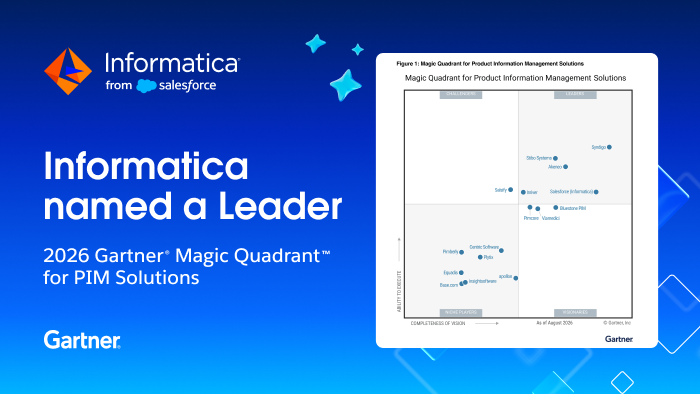
Informatica has been recognized as a Leader in five consecutive Gartner Magic Quadrants, across Augmented Data Quality, Data & Analytics Governance, Master Data Management, Data Integration, and Metadata Management. No other data management platform has been validated across all five. IDMC isn't just comprehensive, it's the only foundation purpose-built to carry the full weight of enterprise AI.
For Providers: The Golden Patient & Provider Record
In provider settings, the Trusted Context use cases center on three high-value problems: care gap closure, credentialing and revenue cycle integrity.
Agentforce agents grounded in a Golden Patient Record can autonomously identify and route care gap outreach, preventive screenings, HCC recapture, chronic disease management — cutting intervention lag from weeks to real time. Because IDMC is headless, that Golden Record is continuously maintained and surfaced to Agentforce without a manual data stewardship step between ingestion and agent action.
For credentialing, a Golden Provider Record automates verification against primary sources including NPPES, DEA and state licensing boards, surfacing real-time status directly into Epic and Cerner scheduling workflows via MuleSoft. Privileging cycles that once took weeks now take days.
For revenue cycle, real-time data quality scoring on patient demographic and insurance eligibility data at point of registration means that Agentforce agents trigger automated remediation before registration errors become claim denials.
Hackensack Meridian Health deployed Informatica MDM on IDMC to consolidate disparate patient records into a trusted Patient 360 view. It enabled real-time care coordination, reduced duplicate records and faster clinical decisions across its 17-hospital system. As they put it: "With Informatica, we have a single, trusted patient identity that powers everything from scheduling to care gap closure."
For Payers: Closing the Reimbursement Integrity Gap
Payer operations are one of the most data-intensive environments in healthcare, and among the most exposed when AI acts on bad data.
Trusted Context for Payers addresses this across six critical workflows:
- Prior authorization
- Member engagement
- Risk adjustment
- Claims integrity
- HEDIS gap closure
- Provider network management
The prior authorization use case is a compelling illustration of what headless MDM governance enables. Whether running on Agentforce or another agentic framework, at the moment of request a prior authorization agent needs to know whether the member’s record is current, whether the clinical policy applies and whether the provider is in-network. IDMC’s headless governance layer ensures the Golden Member Record is always current, regardless of which orchestration engine is executing the workflow, so the prior authorization agent never has to wait on a data refresh or human curation cycle to get accurate context.
Claims integrity is where the real-time nature of headless architecture becomes most visible. Headless MDM governance means fraud, waste and abuse (FWA) signals are detected and flagged the moment a claim enters the system instead of after a batch process runs overnight. That's the difference between preventing an improper payment and recovering it after the fact.
Governing your data isn’t just a compliance investment, it’s a direct line to controlling your AI operating costs, and there’s a financial dimension to data quality that healthcare finance leaders increasingly can’t ignore. Without accurate enterprise context, AI agents suffering from hallucinations won’t just produce wrong answers, they’ll spin into costly retry loops, burning through expensive LLM tokens and cloud compute with each failed attempt. For payers processing millions of claims and prior authorizations at scale, that token waste adds up fast. IDMC’s headless governance layer eliminates hallucination loops at the source, by ensuring agents receive clean, mastered data on the first call. This dramatically reduces the computational overhead of running AI at enterprise scale. Governing your data isn’t just a compliance investment, it’s a direct line to controlling your AI operating costs.
For HEDIS and risk adjustment, FHIR-connected clinical and claims data unified through IDMC identifies undercoded Hierarchical Condition Categories (HCCs) before year-end submission, protecting revenue and improving risk score accuracy through Agentforce-driven prospective closure workflows.
Blue Cross Blue Shield of Massachusetts deployed Informatica MDM and Cloud Data Integration on IDMC to consolidate disparate customer data into a trusted Customer 360. This enabled CMS interoperability, risk adjustment and claims operations across members, providers and business units. Their verdict: "Informatica IDMC improves operational efficiency and member satisfaction through consolidated, standardized, and mastered data."
For Life Sciences: From Data Fragmentation to the Agentic Enterprise
Life sciences organizations face a data trust crisis that spans the full R&D and commercial lifecycle, and the consequences are measured in trial delays, regulatory exposure and patient safety risk. Up to 70% of R&D data is trapped in legacy systems like Veeva, SAP, LIMS, and clinical platforms, and a single mismatched trial participant identity across those systems can create simultaneous compliance exposure under GDPR, GxP and HIPAA.
Trusted Context for Life Sciences addresses this across five critical workflows: clinical trial recruitment, medical information requests, regulatory submissions, HCP engagement, and global supply chain management.
Clinical trial recruitment is a compelling illustration of what headless MDM governance enables. An Agentforce agent needs to know, at the moment of participant matching, whether real-world evidence and clinical data reflect a unified, deduplicated view of the candidate. IDMC's headless governance layer ensures the Golden Participant Record is always current — the recruitment agent never waits on a manual screening cycle or a data steward review to get accurate context.
Medical information requests are where the real-time nature of headless architecture is most visible. Agentforce agents grounded in IDMC-governed research data provide instant, GxP-compliant responses to complex HCP inquiries, ensuring 100% regulatory compliance without a human review queue between the inquiry and the answer. That's the difference between same-day response and a compliance backlog.
For regulatory submissions and supply chain integrity, IDMC leverages CLAIRE® AI to profile pharmaceutical assets and automate protection of intellectual property, reducing the manual burden of SPOR/IDMP submissions by up to 40%. Product 360 golden records enable agents to autonomously navigate supply logs, predict shortages and manage inventory across global borders through patent cliffs and M&A integrations. Critically, IDMC automatically masks PII and PHI before data ever reaches the LLM with compliance enforced at the data layer, not the application layer, where it can't be bypassed.
Gilead Sciences deployed Informatica MDM and Cloud Data Integration on IDMC to consolidate clinical and commercial data across Veeva, SAP, and LIMS into a trusted HCP and trial participant 360 — enabling trial recruitment, regulatory submission automation, and supply chain resilience across 40+ markets. Their verdict: "Informatica IDMC accelerates time-to-therapy and reduces regulatory risk through unified, governed, and enterprise-scale clinical and commercial data."
One Platform. One Source of Truth.
Salesforce completed its acquisition of Informatica in November 2025, making IDMC a native part of the Salesforce Trusted Context portfolio alongside MuleSoft, Data 360, Tableau, and Agentforce. This is one platform, not a patchwork of integrations.
Understanding why both layers are necessary comes down to a single distinction: if Salesforce Headless represents the body of the agentic enterprise — the orchestration layer that lets AI agents take action across business systems — then Informatica Headless is the mind. Salesforce Headless 360 and MuleSoft decouple application logic so agents can orchestrate, run workflows and execute decisions silently in the background. Informatica Headless decouples the data layer, ensuring those same agents are fueled with clean, governed and mastered trusted context every time they act.
The two layers integrate through three native connection points:
- MCP servers that let Salesforce agents query IDMC’s data engine mid-workflow without custom code
- Real-time Golden Record feeds that verify and surface the correct patient, member or HCP record the moment an agent needs to execute a transaction
- Native governance sync between Informatica’s context catalog and MuleSoft’s developer discovery layer, ensuring data lineage, security rules, and privacy policies automatically attach to every API endpoint Salesforce agents orchestrate.
Health system CIOs evaluating the combined Salesforce + Informatica platform must remember: it’s not a patchwork of integrations. It’s a complete loop from raw source data to governed insight to autonomous agent action, with accountability at every step.
The regulatory environment is also creating urgency. CMS interoperability mandates, TEFCA compliance, the No Surprises Act, ACA risk adjustment deadlines, FHIR R4 data sharing requirements, the EU AI Act, and FDA/EMA submission standards are converging simultaneously. Organizations that build the Trusted Context Layer now will be positioned to meet those requirements, while competitors scramble to remediate data problems after their AI agents have already scaled the mistakes.
Trust is the currency of the Agentic Enterprise.
For providers: the question is whether your AI agents can close the loop from patient registration to care gap closure without acting on a fragmented or stale record.
For payers: the question is whether your AI agents can process a prior authorization, adjudicate a claim and close a HEDIS gap accurately, in real time, at scale, without hallucinating on bad member data.
For life sciences: the question is whether your AI agents can recruit a trial participant, respond to a medical inquiry, and manage a global supply chain, compliantly, across jurisdictions, without a data steward in the loop.
Informatica IDMC's headless architecture is the answer to all three questions. It is the governed, real-time data foundation that turns AI agents from high-risk experiments into reliable catalysts for clinical and commercial transformation.
The organizations that invest in Trusted Context today will be the ones whose AI agents close the loop between data and action. From patient registration to the last mile of care. From enrollment to the last mile of the member journey. From trial recruitment to the last mile of regulatory submission. And all at enterprise scale.