“We found that Informatica Cloud Data Integration was the most flexible data integration solution and would be the easiest for business users to adopt. We started using it for the simple use case of backing up new Salesforce leads to our marketing database, and it quickly became the backbone of our marketing data ecosystem.”




Use Informatica Headless and CLAIRE® AI at no additional cost
Power your Agentic Enterprise with AI-ready data
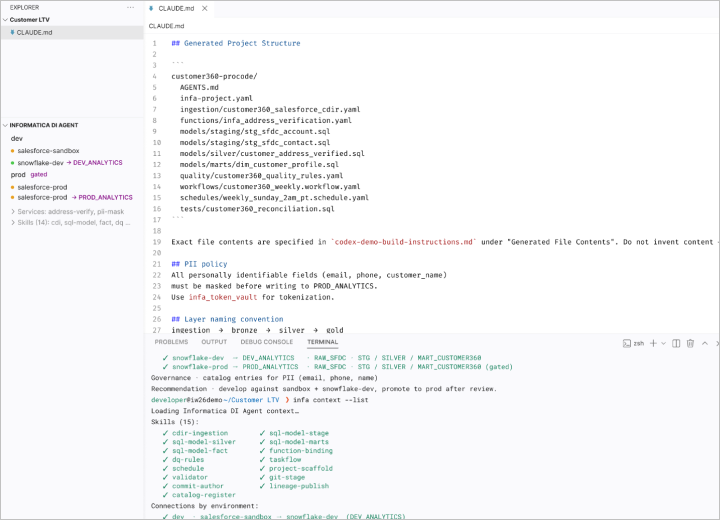
Build anywhere with headless
Build, validate, and deploy AI-ready data pipelines from any development environment. Allow pro-code and low-code developers to work in their preferred tools, including Claude and other MCP-enabled environments.
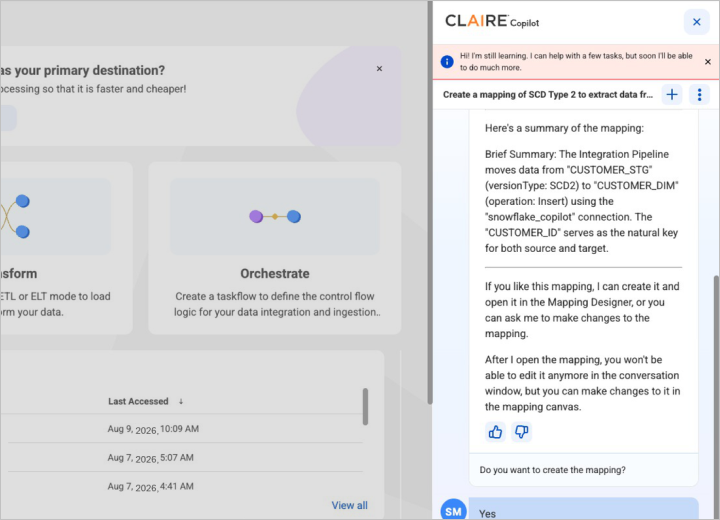
Automate pipelines with AI
Accelerate productivity with CLAIREⓇ Copilot for Data Integration through AI-assisted pipeline generation and summarization. Use natural language to automate routine data engineering tasks effortlessly.
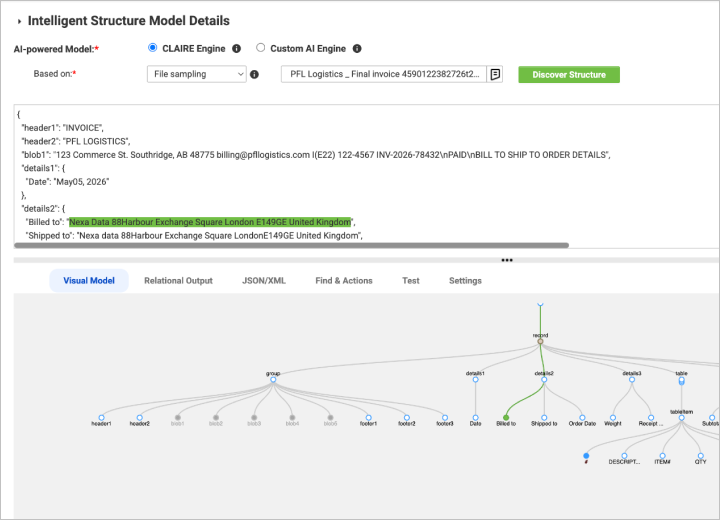
Deliver AI-ready data
Power your Agentic AI initiatives by transforming complex unstructured data into AI-ready context for vector databases and RAG architectures.
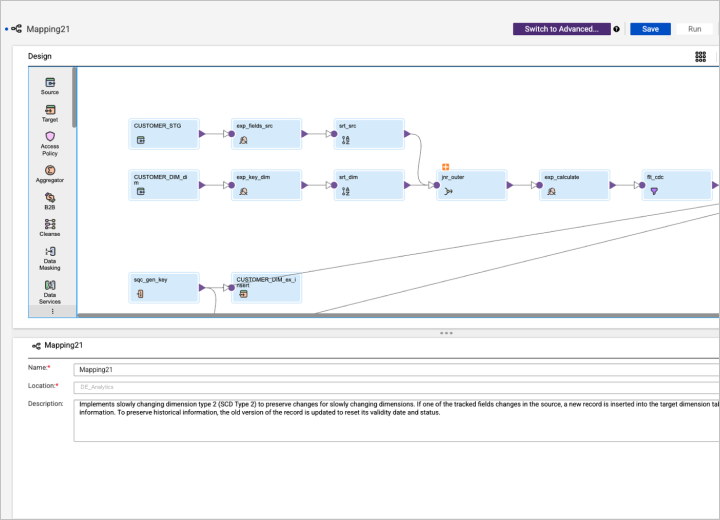
Fuel modern data architectures
Ingest data into cloud data warehouses and lakes with high-performance ELT/ETL, data replication or change data capture. Leverage modern architectures with support for open table formats.
Pay only for what you use with our flexible pricing.
Explore related Cloud Data Integration services
As a leading part of the AI-powered Informatica Intelligent Data Management Cloud (IDMC), Data Integration & Engineering works with a range of complementary services.
Make hundreds of connections easily and seamlessly.
Key Data Integration and Engineering resources
ANALYST REPORT
2025 Gartner® Magic Quadrant™ for Data Integration Tools


The $22M Question: Is your Data integration d Delivering ROI?
Accelerate Modern Analytics and AI with Cloud Data Integration and Engineering

Simplify Data Integration with Cloud ELT
FAQ for Informatica Data Integration and Engineering
Cloud data integration is the process of consolidating and synchronizing data from disparate sources, such as on-premises systems, cloud applications and third-party platforms, into a unified, central cloud environment. By automating data pipelines and breaking down information silos, it enables real-time analytics, seamless data sharing and a single source of truth across an entire organization.
Informatica Data Integration and Engineering helps automate routine tasks with low-code/no-code tools, reducing the amount of time and resources required.
Informatica Data Integration and Engineering provides visibility into workloads and pipeline with auto-tuning capabilities.
Informatica Data Integration and Engineering supports data fabric, data mesh and data lakehouse, among others.
Informatica Data Integration and Engineering supports data replication and change data capture (CDC) through Informatica Cloud Mass Ingestion.
The primary difference between ETL (Extract, Transform, Load) and ELT (Extract, Load, Transform) lies in the sequence and location of data processing. In ETL, raw data is transformed on a separate staging server before being loaded into the destination system, which is ideal for strict compliance requirements and legacy infrastructure. In contrast, ELT loads raw data directly into a destination, typically a modern cloud data warehouse first, and then transforms it using the target system's cloud compute power, enabling significantly faster data ingestion, greater flexibility and lower processing costs for big data.